Sunday, August 23, 2015

What I Want School to Provide

Sometime this summer, in-between packing up one office and unpacking in a new office, I came across a particular sheet of paper that caught my attention.

The paper was from an activity that Mike Mattos had done with the attendees of some Response to Intervention (RtI) professional development that he'd delivered in Cedar Rapids several years ago.

The task was to fill-in the following blanks -
What I want school to provide ___________________________________________________

is

___________________________________________________ (Using only 10 words or less).

At the time, my son, Ryne, was two-(almost three) years old. I filled-in his name in the first blank and the words, "A caring environment that pushes him to his full potential."

(Mattos, too had his child's/children's name in the first box; he only used two words for his box - "Endless possibilities.")

Let's return to the present. My son is going to begin preschool in a little over a week. It's funny how your life experiences over time change your perspective and your philosophies. More so now than ever before, as my son is approaching the start of his education career in a school setting, part of my decision making process is to consider things through a parent's perspective. Is this what I would want in regards to Ryne's or Olivia's (my one-year old daughter) educational experience?

It would be hypocritical for me to expect anything less than what I'd want for my children.

To close our back-to-school staff  meeting, I tried to convey to our staff my priority of considering a parent's perspective when making decisions. Each one of our student's are another person's entire world, their most prized possession, their heart and soul, their entire life. Parents put a lot of faith in us as educators to care for their children for a large portion of the day, week, month, year. It is a huge responsibility that we must embrace.

I asked our staff to complete the sheet that Mattos had originally introduced to me. I didn't collect these, I just wanted staff to think about the education that they would want for the children that they love the most. I asked them to keep these, maybe they will even refer to them a time or two as we progress through the year.

Ultimately, my hope is that wherever I am, my school reflects the expectations that I have for my own children's education.
My sheet did not look terribly different than it did several years ago. There were some minor tweaks, but a majority of my response (above) was very similar.

Friday, July 31, 2015

The Bix and a Real World Growth Mindset

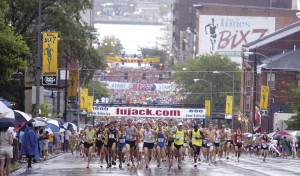
Every summer, in late July, Davenport hosts approximately 20,000 runners for a seven mile road race called The Bix 7. When Amy (who would become and is my wife) and I moved to Davenport, in 2006, I started to run the Bix.

Let me share a little bit about my background experience as a runner prior to 2006. I wasn’t a runner. In my opinion, two-miles was the maximum distance that I was willing to run. Most of my running had been done in-order to get in-shape for an upcoming football season. I had participated in track and field in high school, but the purposes were a) the football coaches thought highly of this participation, and b) for socialization purposes. In fact, when the track coach would assign the team a seven mile run, I would (along with a couple of other friends) find a place to hide-out where we could wait out the run before returning at an appropriate time.


Anyways, my first year running the Bix, in 2006, was grueling. It took me 68 minutes to finish. And I remember thinking that if I could just get through these seven miles that I would never again have to run seven miles. Well, I ran it again that next summer and that next summer I ran it a little bit faster that I had the previous summer. In fact, just last month, I ran my best Bix ever. I finished with a time somewhere in the 53 minute range. I’ve shaved 15 minutes off of my time!

Professionally, lately, I’ve been very interested in learning about Carol Dweck’s theories of mindset. My experience with the Bix is my real world example of a growth mindset. My abilities as a runner developed and improved over time. Make no mistake, I didn’t just go from dreading running the Bix to loving running the Bix. I didn’t just go from running the Bix in 68 minutes to running the Bix in 53 minutes. There were multiple, crucial factors involved in this transformation.


  • Practice, Improvement, and Enjoyment - I’ve run (and trained) for eight Bix races, five half-marathons, and multiple other 10K, 5K and other road races. I’ve put in a lot of time running. I don’t know how it compares to the 10,000 hours that Malcolm Gladwell talks about needing in-order to become really good at something, but I do know that it has been a major time commitment. Committing your time, leads to improvement; experiencing improvement is enjoyable. Because something is enjoyable, you are likely to continue to commit your time to that area.

  • Passion - Not surprisingly, somewhere along the way I became passionate about running. It is great exercise, it is a great form of stress release, and it is a great opportunity to think through new ideas. It is painful for me to imagine not being able to run. In fact, I have become especially fond of spring time when the weather starts to become more favorable to resume outdoor running.

  • Goals - Herman Edwards says, “A goal without a plan is a wish.” I set incremental goals for myself in regards to my races, and I map out a training plan that allows for me to reach my goals. I’m aiming for a number that is a little bit better than what I’ve previously accomplished. I’m religious about my training plan and not skipping any of the runs that will help me reach my goals.

This is the same model that we need to be aware of in regards to educating our students in our schools. Too often students come to school and just get through it; they do not enjoy it, sometimes even dreading it, which limits what they get from their school experience. Worse yet,  and instead they sometimes dread it. Students can spend their entire educational lives feeling this.
It is our job, as educators, to help students find their passions. It is our job, as educators, to help students set goals and plans that will allow them to achieve those goals. And it is our job, as educators, to give students opportunities to practice so that they can see incremental improvements that will result in their enjoyment of learning and their enjoyment of school.

Translate